
7 Off-Grid Campsite Ideas for a Cozy Forest Retreat
These seven practical off-grid campsite ideas show how solar lighting, a simple water system, an outdoor kitchen and thoughtful details can create a comfortable forest retreat without electricity or running water.
Creating a comfortable campsite without electricity or running water may sound challenging, but the right off-grid campsite ideas can make even a simple forest setup feel warm, practical and quietly luxurious.
My own off-grid campsite sits on a meadow at the edge of the forest, around 200 meters from the nearest road and half a kilometer from the next farmhouse. It is a place shaped by birdsong, rustling leaves, bright stars and the occasional deer wandering close to the tent in the morning.
The site was designed for two people, with privacy, comfort and a slower rhythm in mind. Over several seasons, I have learned that successful off-grid camping is not about adding more equipment. It is about choosing a few reliable solutions that make everyday tasks simple while preserving the feeling of being close to nature.
These seven practical off-grid campsite ideas cover the areas that have made the greatest difference in our own setup, from solar lighting and water storage to a covered kitchen, dry toilet and cozy campfire space.
Save this idea for later
Idea #1: Create a Comfortable Sleeping Area for Your Off-Grid Campsite
A beautiful location matters, but a comfortable bed is what turns camping into glamping.
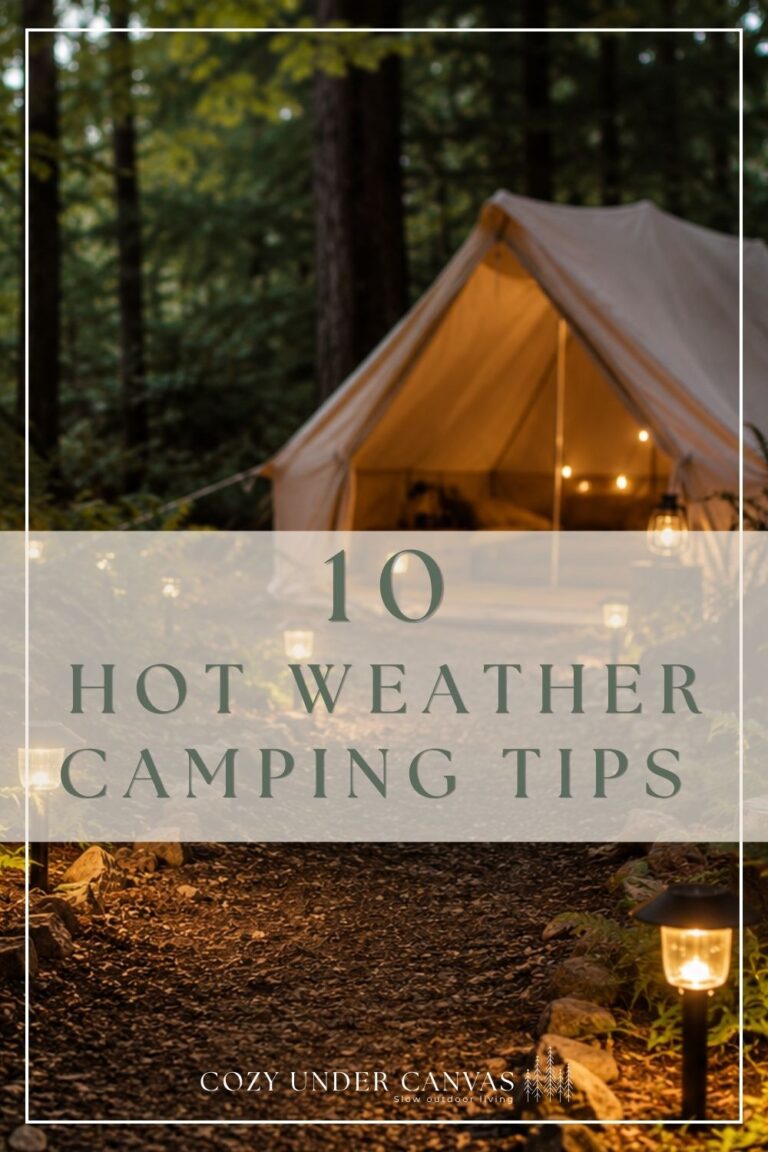
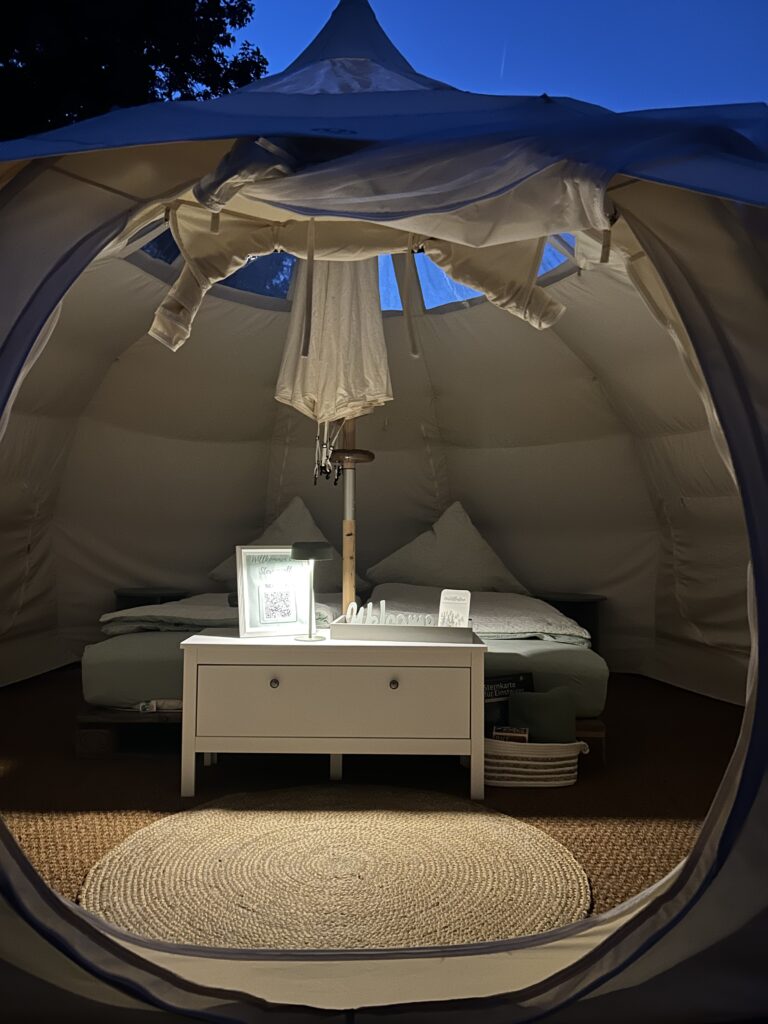
Our four-meter Lotus Belle Stargazer tent stands on a wooden platform.
Inside, a simple pallet bed supports two 90-by-200-centimeter mattresses. The mattresses are around 30 centimeters deep, which creates a much more substantial, hotel-like sleeping experience than a thin camping mattress.
Natural textures help soften the practical structure. A jute rug covers part of the floor, while white wooden furniture, sage accents and high-thread-count cotton bedding in cream and muted green keep the interior calm and connected to the surrounding landscape.
The lesson is simple: do not try to recreate a full indoor bedroom. Focus on the things that make the greatest difference:
- a level and dry base,
- a genuinely comfortable mattress,
- fresh natural bedding,
- soft rugs and blankets,
- and enough enclosed storage to prevent clutter.
Idea #2: Use Solar Lighting Throughout Your Off-Grid Campsite
Lighting has one of the greatest effects on the atmosphere of an off-grid campsite.
Rather than trying to illuminate the entire site, use several small light sources in the places where they are actually needed.
Rechargeable solar lanterns [affiliate link] have proven far more useful than conventional flashlights. Guests tend to leave a lantern beside the bed or carry it to the seating area, while the flashlights are rarely used unless someone needs a stronger, directed beam.
A motion-activated rechargeable nightlight [affiliate link] inside the toilet is one of the smallest but most practical additions. Guests do not need to search for a switch in the dark, and the light only turns on when it is needed.
Warm solar string lights [affiliate link] add atmosphere without requiring guests to manage batteries or cables. Whenever possible, I choose lighting that recharges itself during the day. This reduces maintenance and keeps the setup genuinely off-grid.
For a practical lighting plan, concentrate on four zones:
- the tent interior,
- the path to the toilet,
- the kitchen and dining surface,
- and the entrance to each structure.
The goal is not to make the forest bright. It is to create enough gentle light to move safely while preserving the darkness and the view of the stars.
Idea #3: Build a Practical Off-Grid Campsite Kitchen
An off-grid kitchen does not need to support complicated cooking.
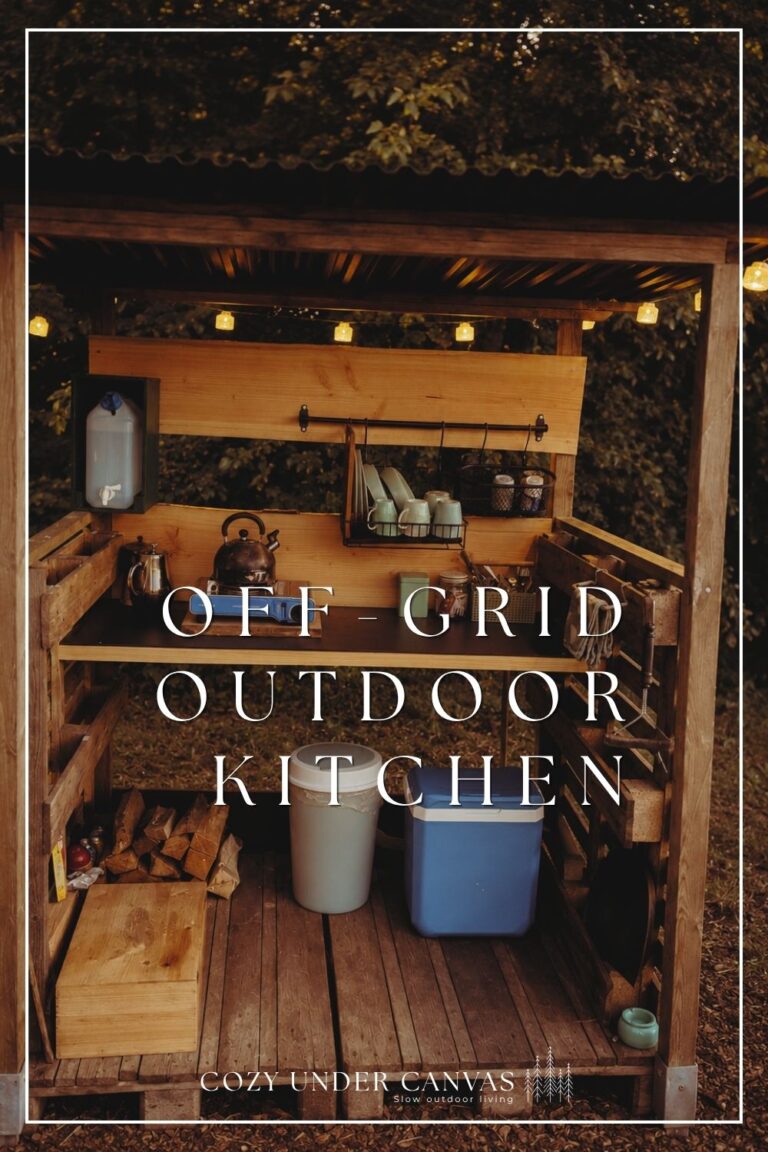
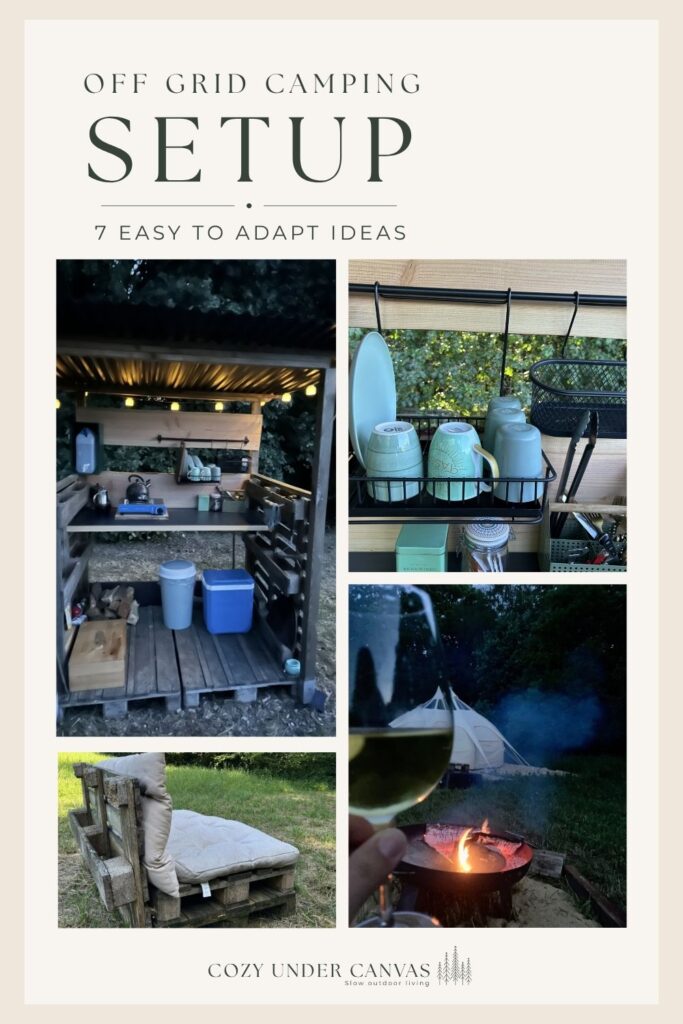
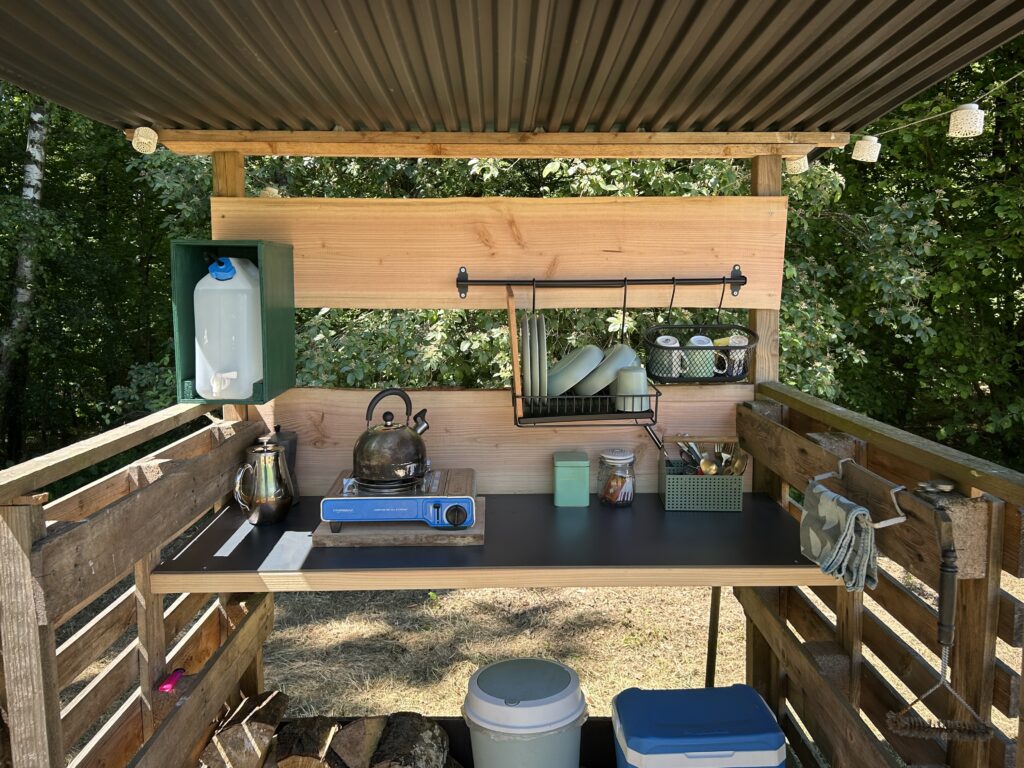
Our small forest kitchen is built from pallets and covered by a roof. It includes a single-burner gas stove, a water container, a work surface and compact storage. The counter is made from a six-millimeter HPL multipurpose building panel, which provides a practical, easy-to-clean surface.
Wall rails and hanging organizers from IKEA keep frequently used items above the counter, while dishes are stored in an old wine crate beneath it. A hanging dish rack allows washed items to dry without taking up valuable work space.
For drinking water, I provide a freshly filled 10-liter water container with a tap [affiliate link] before every stay. Ten liters is generally sufficient for two people staying between one and three nights, although the required amount will depend on weather, cooking habits and access to additional water.
One of the most frequently used pieces is the stovetop espresso maker [affiliate link] . It requires no electricity, takes up little space and makes the morning coffee ritual feel more intentional.
I also provide a durable kettle [affiliate link] for heating water. It can be used on the gas stove and, with sufficient distance from the flames, on a grate above the fire. Because the handle includes heat-sensitive elements, it should not sit directly in high flames.
If I rebuilt the kitchen today, I would consider converting a wooden garden cabinet into a closable outdoor kitchen. Doors would protect the equipment more effectively and make it easier to hide visual clutter when the kitchen is not being used.
That is an important principle for any small campsite: open storage is convenient, but closed storage makes the space calmer and protects supplies from weather, dust and insects.
Idea #4: Create a Simple Hand-Washing System Without Plumbing
Running water is convenient, but it is not the only way to create a functional washing area.
Next to our Trobolo dry toilet, we built a small open-air wash station from pallets. It uses a 30-liter freshwater container, a basin, a separate wastewater container and a hose system connected to a foot-operated water pump [affiliate link] .
Pressing the pump with one foot moves water from the freshwater container to the tap. This leaves both hands free for washing and uses no electricity. It is a simple mechanical system, but guests are often surprised by how well it works.
A biodegradable travel soap [affiliate link] completes the setup. Because the system is outdoors and the wastewater must be managed responsibly, it is important to use products suitable for the intended disposal method and local environmental conditions.
The main components of a basic off-grid wash station are:
- a freshwater container,
- a clearly separate wastewater container,
- a stable basin,
- a manual or foot-operated pump,
- a suitable soap,
- and an easy way to access and clean every part of the system.
All containers and hoses should be emptied and rinsed thoroughly between uses. Any system involving stored water requires regular cleaning and inspection rather than simply being refilled indefinitely.

Idea #5: Make a Dry Toilet Easy to Understand
A dry toilet can feel unfamiliar, but it does not need to feel uncomfortable.
Our Trobolo toilet stands in its own purpose-built toilet house. The interior is simple, private and well maintained. A rechargeable motion-sensor light [affiliate link] provides automatic lighting at night, while the separate hand-washing station is positioned immediately beside the building.
Clear communication matters as much as the physical setup. An illustrated instruction poster is laminated and attached to the inside of the toilet door. It explains the process briefly so guests do not have to ask questions or worry that they are using the system incorrectly.
Transparency before arrival is equally important. Guests should know that there is no conventional plumbing or electricity before they book or visit. When the right expectations are set, an off-grid toilet is rarely a problem.
In fact, guests frequently comment on how efficient and thoughtfully designed the entire system feels. The creative solution becomes part of the experience rather than an inconvenience.

PRACTICAL OFF GRID SOLUTIONS
Rechargeable motion-sensor nightlight
10-liter drinking-water container with tap
[Affiliate / Adverts]
Idea #6: Create One Sheltered Space for Eating, Reading and Resting
Even in summer, an outdoor campsite needs a place that remains useful during light rain, strong sun or cool evenings.
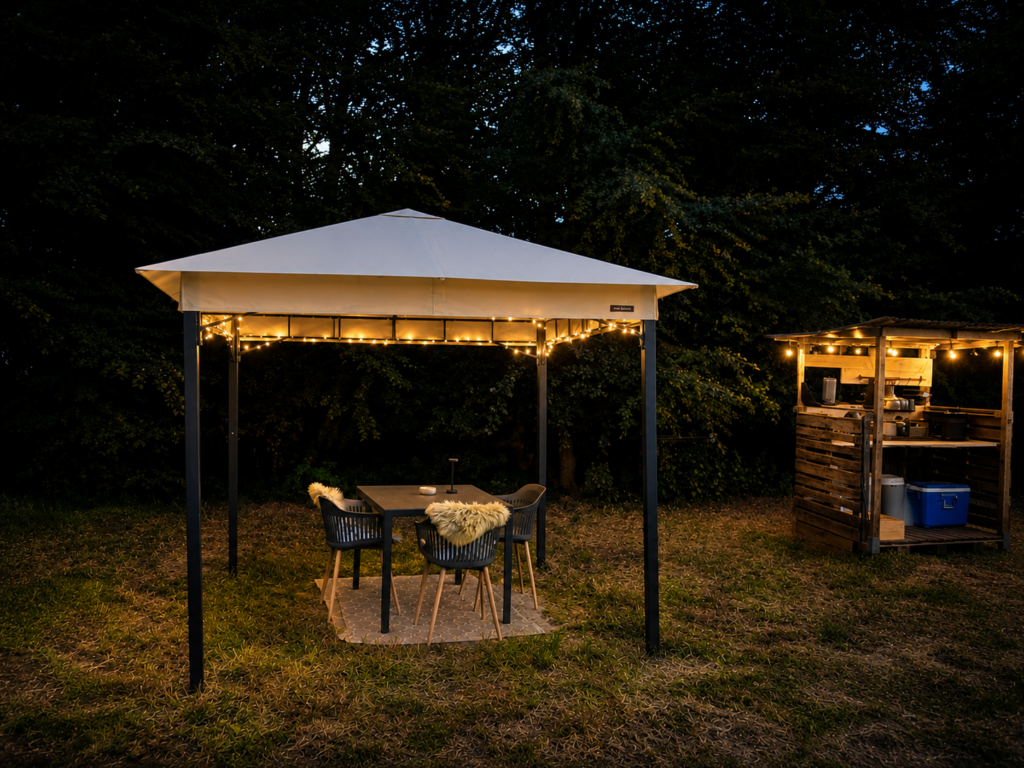
Our three-by-three-meter pavilion acts as both dining room and outdoor living room. Beneath it are a table, three chairs and a simple pallet sofa. The sofa is made from two stacked pallets with a third pallet secured vertically as the backrest.
Outdoor-rated pallet cushions are essential. Indoor cushions may look beautiful initially, but they absorb moisture too easily and create unnecessary work. The aim is to build a seating area that guests can use without needing to carry everything inside whenever the weather changes.
The pavilion is used for meals, card games, reading and long conversations. Solar fairy lights [affiliate link] provide most of the atmosphere after sunset.
This sheltered area is especially important because it gives the campsite a center. The tent remains a place for sleeping and retreating, while the pavilion provides somewhere to spend the day. Most importantly, it should not create chores for the people using it. Nothing in our seating area needs to be packed away overnight.

Idea #7: Turn the Campfire Area Into an Outdoor Living Room
The campfire is where the off-grid experience often becomes most memorable.
Our fire area sits approximately 15 meters from the forest, tent and pavilion. It includes a raised fire bowl and a traditional suspended grill. Sand surrounds the immediate fire area, and a fire extinguisher is kept nearby. Firewood, kindling and a lighter are provided, and guests may make their own fire when weather and local safety conditions allow it.
Tree trunks provide simple seating, while chairs from the pavilion and the pallet sofa can also be used nearby.
The difference between a purely functional firepit and a cozy gathering place often comes down to a few details. Durable wine glasses [affiliate link] make an evening drink feel special without the risk of fragile glass around the campsite. A warm wool blanket [affiliate link] allows guests to remain outside after the temperature drops.
A kettle can also be used to prepare tea or hot water above the fire, provided it is positioned safely and is suitable for the heat source.
Guests often describe the same feeling: they do not have to do anything. The fire slows the evening naturally. It creates space for conversation and removes the need for entertainment.
That peaceful atmosphere is difficult to manufacture with decoration alone. It comes from having privacy, darkness, comfortable seating and enough time to stay beside the flames.
Which Off-Grid Campsite Ideas Make the Biggest Difference?
The best off-grid campsite ideas are not always the most complicated ones.
At our forest campsite, the greatest improvements came from solving a few everyday needs well: comfortable sleeping, reliable lighting, clean water, sheltered cooking, simple hygiene and a warm place to sit after dark.
The seven details that have made the greatest difference in our own setup are:
- a foot-operated water pump,
- rechargeable solar lanterns,
- warm solar string lights,
- a covered outdoor kitchen,
- a solar power bank,
- durable but attractive wine glasses,
- and real wool blankets.
Together, these simple additions make camping without electricity or running water feel comfortable rather than restrictive.
The real luxury of an off-grid forest campsite is not modern technology. It is privacy, quiet, darkness, fresh air and the chance to slow down. The practical elements should support that experience without distracting from it.
Choose one of these off-grid campsite ideas as your starting point and improve your space gradually. A single reliable light, a comfortable seat or a better water system can completely change the way an outdoor retreat feels.

SHOP MY COZY OFF GRID GLAMPING SETUP [Affiliate / Adverts]
Affiliate disclosure: I only recommend products that I personally use and that both I and my glamping guests have been happy with. Some links in this article are affiliate links. If you make a purchase through one of these links, I may earn a small commission at no additional cost to you. By using these links, you help support Cozy Under Canvas and allow me to continue creating helpful camping and glamping content.